Four years later, KU researchers continue their work strengthening American dams
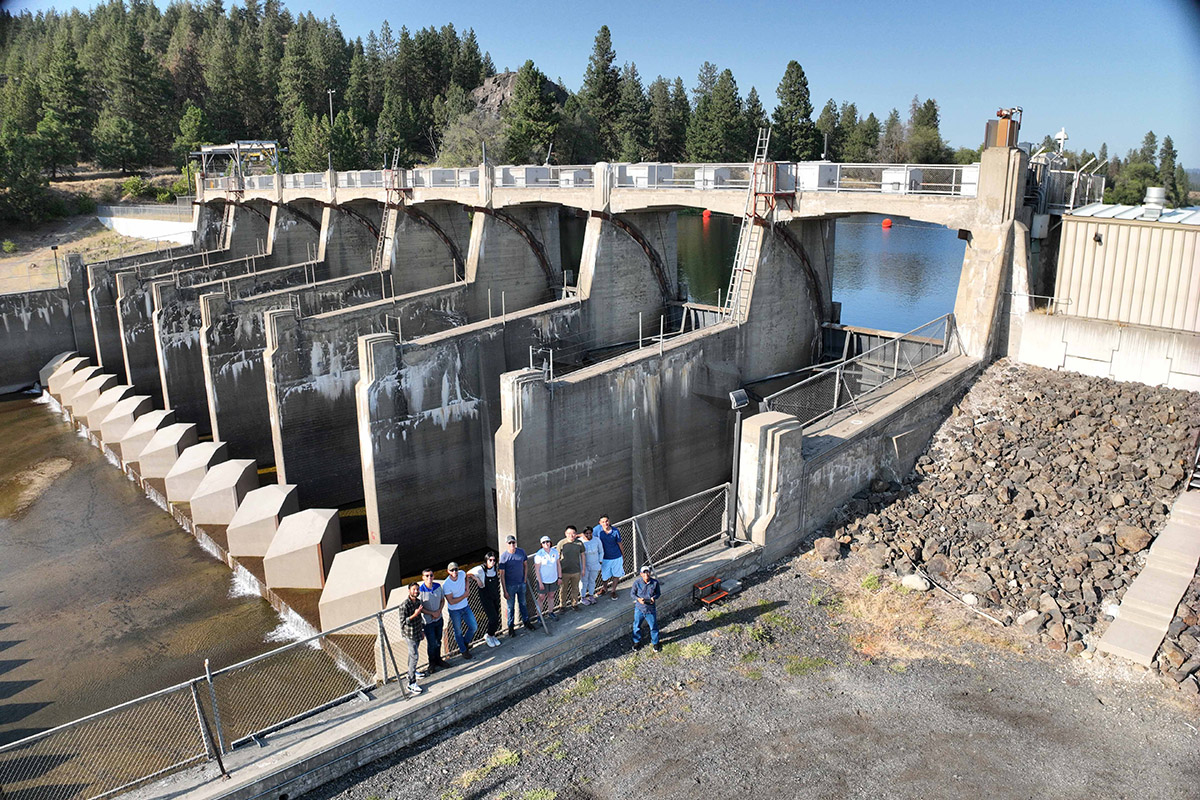
LAWRENCE – Nearly four years after launching a federally funded research initiative to strengthen American dams and levees, University of Kansas engineers are demonstrating how that work is delivering measurable benefits to Kansas infrastructure, workforce development and public safety.
The $7.7 million, five-year project is a partnership among KU, the U.S. Army Engineer Research and Development Center (ERDC), the Department of Homeland Security’s Science and Technology Directorate and the U.S. Army Corps of Engineers.
Work at KU is headed by Caroline Bennett, now chair of the Department of Civil, Environmental & Architectural Engineering and Charles E. & Mary Jane Spahr Professor.
“The research has progressed by leaps and bounds,” Bennett said. “We’re now starting year five of the project, and we’ve accomplished an incredible amount of work that will directly pay off in more resilient dam structures.”
The project focuses on developing less costly and longer-lasting methods for repairing and retrofitting concrete dams across the U.S., integrated with artificial intelligence and high-fidelity digital twin technologies to support advanced structural inspection and health monitoring.
Other key contributing department faculty members are Jian Li, Rémy Lequesne, William Collins, Amy Hansen, Andrés Lepage, David Darwin and Matt O’Reilly.
The research team has been studying fiber-reinforced polymer materials, or FRPs, to address damage and strengthen concrete dam structures. FRPs are well-accepted for use in strengthening existing building and bridge structures in civil infrastructure and are regularly used in other industrial applications, but they do not have a track record of being used in concrete dams.
The FRP repairs and retrofits being developed are targeted at restraining sliding and opening at lift joints in concrete gravity dams, restraining rocking at crest blocks and repairing damage on concrete spillways.
In addition to preventing and repairing damage, the researchers have structured the project to leverage artificial intelligence and advanced 3D modeling to support efficient inspection and monitoring of concrete dams. This framework integrates drone imagery, photogrammetry and machine learning to identify, localize and map damage such as cracks and spalling onto detailed 3D models of dam structures.
“The machine learning aspect allows us to look at imagery of the dam and use AI to pinpoint where there are cracks so they can be tracked over time and localized for repair,” Bennett said. “We have constantly improved the machine learning over time, and it has become more precise as the work has matured.”
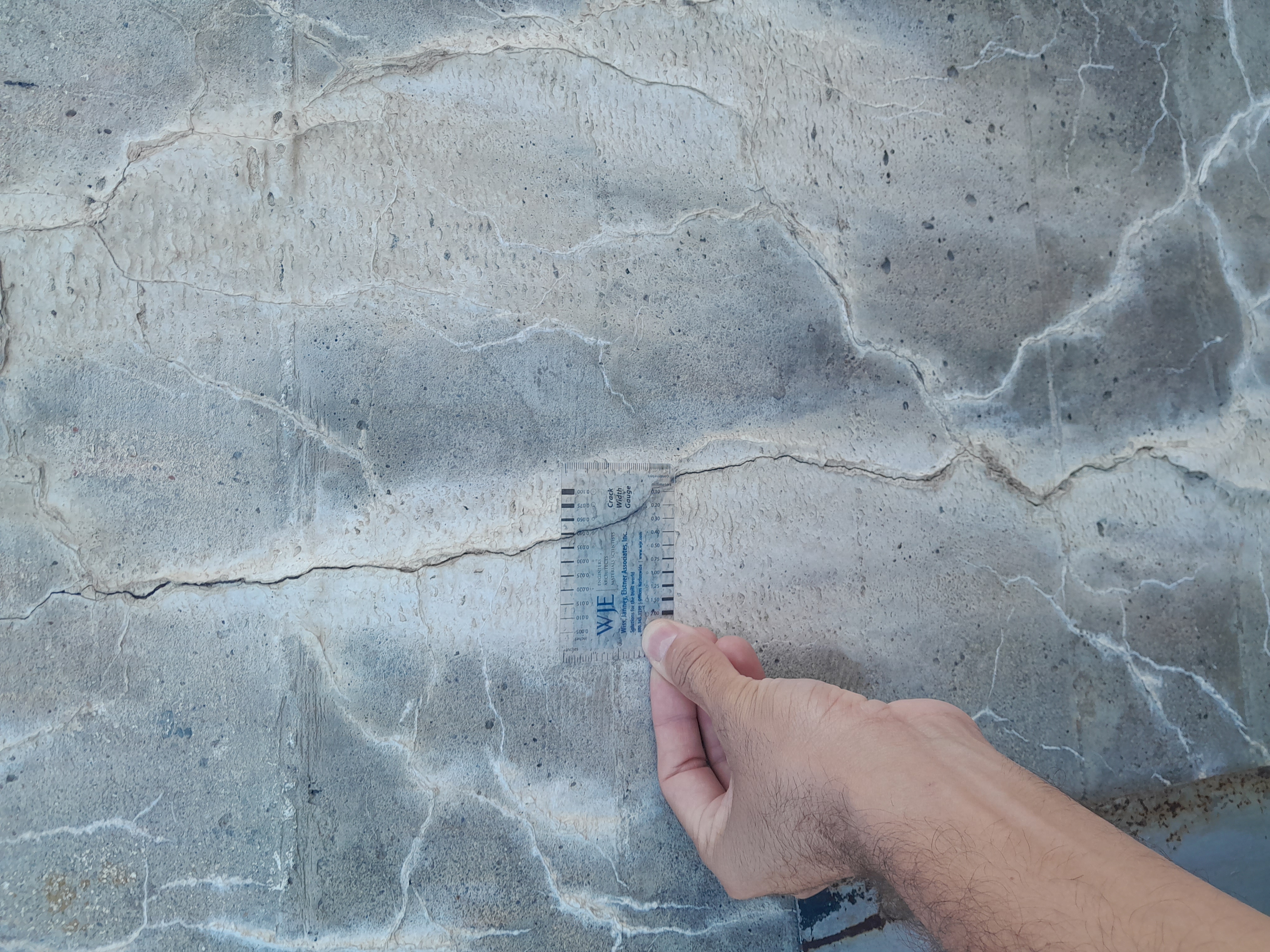
These technologies have already been applied to two dams in the United States: the Upriver Dam in Spokane, Washington, and Tuttle Creek Dam in Manhattan. The Tuttle Creek Dam is one of Kansas’ most significant flood-control structures.
“Our approach goes beyond detecting damage by placing each defect within a 3D context and continuously updating the model with new inspection data,” said Jian Li, Deane E. Ackers Professor of Civil, Environmental & Architectural engineering. “This provides engineers with a clearer picture of how damage evolves over time and supports more informed maintenance decisions.”
The ability to model dam surfaces in 3D and detect localized cracking provides infrastructure managers with more efficient tools to monitor structural health and prioritize maintenance.
Beyond detection, KU researchers have made major advances in strengthening damaged concrete using FRPs, but applying this material to massive concrete dam structures presents unique engineering challenges.
“There are so many unknowns and variables when we’re applying FRPs to a totally different type of structure than those they’ve been applied to in the past,” Bennett said. “It’s taken a lot of fundamental research to adjust to those challenges.”
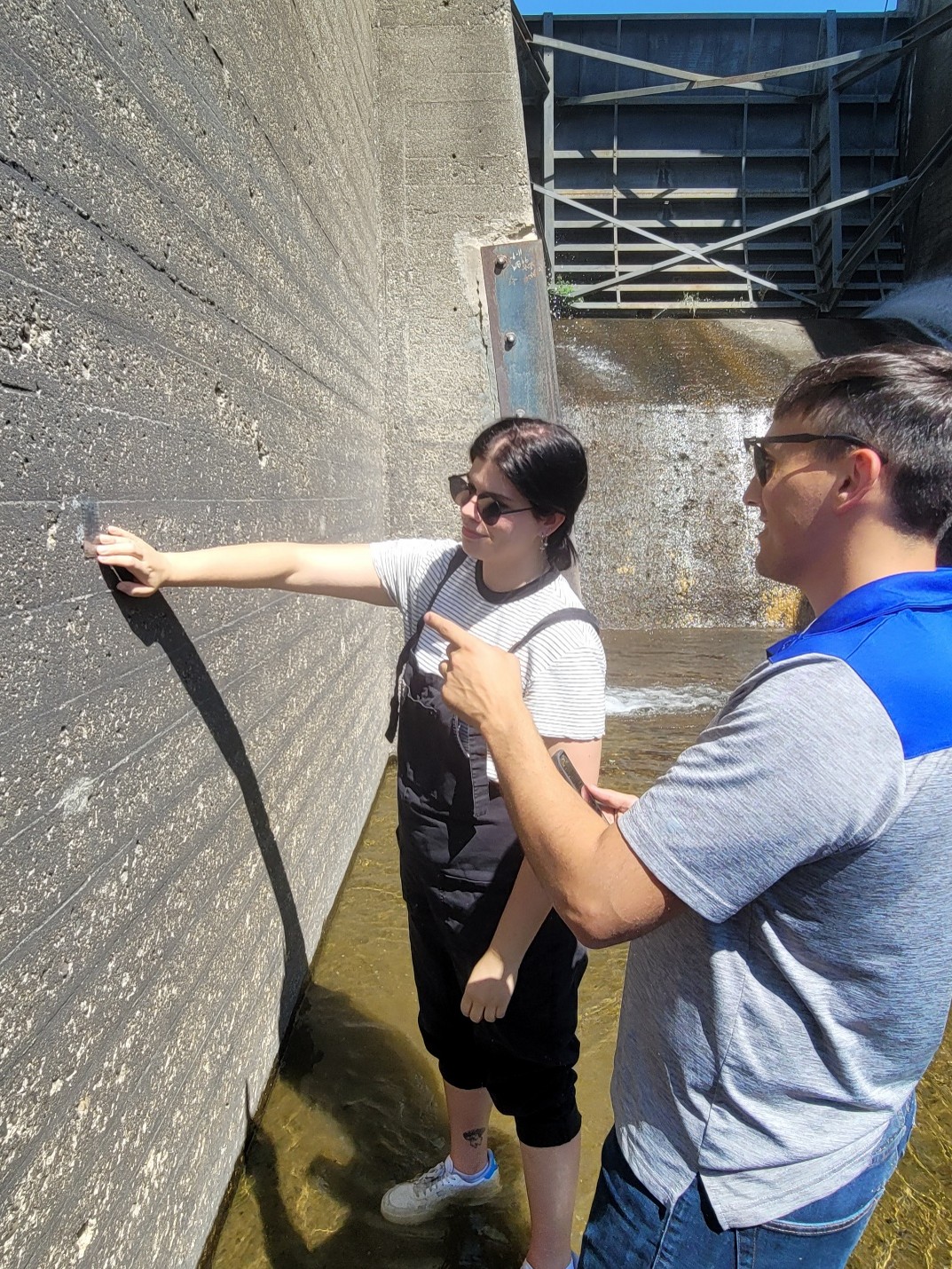
Doctoral student Adam Mouak has been working on small-scale testing to characterize how FRP-concrete bond performs under various loads and environmental conditions.
“The conditions on dams are extremely harsh, so it is critical to quantify these effects and ensure the repairs are both durable and long-lasting,” Mouak said.
The KU team has also conducted large-scale structural tests that led to a better understanding of the bond behavior between FRP and concrete under various dam-specific environmental and load conditions. This has led to the development of anchorage techniques for FRP laminates and post-tensioning repair strategies using FRP strands.
“We have successfully applied the FRP to concrete and tested it at a large scale,” Bennett said. “We’ve gotten robust results in terms of the bond between the FRP and the concrete in very demanding applications. Bottom line, it’s proving quite effective.”
The project has involved many people over the past few years, including undergraduate students, master’s and doctoral students, postdoctoral researchers and faculty across multiple disciplines.
“It’s gratifying to have such a great team who are working together to answer tough, technical questions that also have such a direct impact on infrastructure in Kansas and across the U.S.,” Lequesne said.
Their work has ranged from large-scale structural testing to smaller-scale materials research, to training deep learning models to locate and quantify damage in dams.
“A major challenge in training AI models for large infrastructure is not just collecting data, but accurately labeling it so the system can learn from it,” Li said. “Our team has developed new approaches, including human-AI collaboration and synthetic data generation, that reduce the need for extensive manual labeling and make this process much more efficient and reliable.”
All this work is paying dividends for the people of Kansas and beyond.
“This project brings together advances in materials, structural engineering and data-driven technologies to address key challenges in dam safety,” Bennett said. “These efforts are helping improve the resilience and long-term performance of critical infrastructure.”
The most recent phase of the project will conclude in April 2027, and the team is working with federal agencies to move the research into practice.
“The next phase is really going to be focused on translating results into the field,” Bennett said.